
St. Joseph County Criminal Court Records
A criminal court record is the court case file opened after criminal charges are filed. In St. Joseph County, criminal case work is strongly tied to Superior Court. Research from the county shows four Superior Court judges hear criminal cases, with felony work centered in the Superior Court Felony Division and misdemeanor matters tied to the Traffic and Misdemeanor Division. Circuit Court has general jurisdiction and may handle limited criminal matters such as criminal nonsupport, welfare fraud, grand jury proceedings, and civil protective order court. St. Joseph/Walkerton Town Court may handle certain local ticket matters.
The criminal court record should not be confused with an arrest record. The arrest side may involve law-enforcement reports, jail booking, custody status, and police records. The criminal case file is the court record for charges, court dates, motions, orders, pleas, trial activity, disposition, sentence, bond, and financial entries. The charge detail itself can be reviewed more closely through St. Joseph County court charge records, while the complete court-file framework belongs in the broader St. Joseph County court records access process.
Search St. Joseph County Criminal Cases
Public St. Joseph County criminal court records are searched through Indiana MyCase when the case is public and in an Odyssey court. MyCase supports case-number, party-name, citation-number, cross-reference, and attorney searches. For a criminal case, the best search is a known case number. A name search should be narrowed with first name, middle name, date of birth, file-date range, status, or court filters when possible. Date of birth helps narrow the search but does not display in case details.
- Open MyCase and search by case number, defendant name, attorney, or citation number when a citation is tied to the criminal case.
- Confirm that the court, case type, and party match St. Joseph County before relying on the result.
- Review the charge section for offense description, statute, degree, offense date, and citation information.
- Read the chronological case summary for arraignment, hearings, motions, orders, plea, disposition, sentencing, and bond events.
- Contact the Clerk of the Circuit Court and Superior Court for official copies, certified copies, older files, non-linked documents, and official balances.
For cases that are still under investigation or outside the court file, the record path changes. SJCPD Records Division handles police reports and background-check requests. The Prosecuting Attorney's FAQ material says ongoing case records generally release only the probable cause affidavit and criminal information or charges unless subpoenaed, and investigatory records are discretionary. That means a public court search may not show every police, prosecutor, or investigative record connected to the same incident.
St. Joseph County Criminal Case Flow
Criminal court records build over time. The first public case entries may identify the charge and court. Later entries show how the case moves through hearings, motions, plea negotiations, trial settings, disposition, sentencing, and post-judgment events. A case may end with dismissal, acquittal, guilty plea, trial conviction, diversion-related result, sentence, probation, or another court order. The docket history is useful, but a certified copy or full document may still require clerk access.
Case flow: Charges Filed › Arraignment › Pretrial / Motions › Plea or Trial › Disposition › Sentencing
| Stage | What Happens |
|---|---|
| Charges Filed | The prosecutor files the criminal information, charge, or related charging document that opens the court case. |
| Arraignment | The defendant is advised of the charge and plea issues are addressed. |
| Pretrial / Motions | The court handles hearings, motions, continuances, discovery issues, bond, and case-management events. |
| Plea or Trial | The case moves toward a negotiated plea, bench trial, jury trial, dismissal, or other result. |
| Disposition | The court records the outcome of a charge or case, such as guilty, dismissed, acquitted, or another final status. |
| Sentencing | The court enters punishment, probation, fines, costs, conditions, or other sentence terms after conviction. |
What St. Joseph County Criminal Court Records Show
Criminal court records in St. Joseph County can include felony, misdemeanor, murder, miscellaneous criminal, and older felony class codes. Indiana Administrative Rule 8 includes codes such as MR for murder, F1 through F6 for felony levels, older FA through FD felony classes, CM for misdemeanor, and MC for miscellaneous criminal. The record may show a case header, parties, attorneys, charges, bond, events, documents, dispositions, sentencing, and financial items. Active warrant flags may appear in party detail when available, but warrant searches should be confirmed through the proper court or warrant channel.
| Field | What It Shows |
|---|---|
| Case Number | The St. Joseph court identifier, filing date segment, criminal case-type code, and sequence number. |
| Court | The division handling the criminal case, such as Superior Court Felony or Traffic and Misdemeanor. |
| Defendant | The person charged, with protected personal details masked when required. |
| Attorneys | Prosecutor and defense counsel information when listed in public party fields. |
| Charges | Offense description, offense statute, offense date, citation number if any, degree, and modifications. |
| Bond | Bond number, amount, status date, and related appearance information when present. |
| Hearings | Arraignment, pretrial, trial, sentencing, compliance, or violation events in the chronological case summary. |
| Plea | The defendant's formal response or plea agreement activity when entered. |
| Disposition | The outcome of a charge or case, such as guilty, dismissed, acquitted, or judgment entered. |
| Sentence | Probation, jail or prison term, fines, costs, conditions, and sentencing events when public. |
| Documents | Public downloadable filings or orders when MyCase permits online access. |
| Financial | Amounts owed, credits, payments, and balances that should be verified with the clerk. |
Charges vs Convictions in St. Joseph County
A charge is an accusation filed in court. A conviction is an outcome after a guilty plea, verdict, or other finding of guilt. St. Joseph County criminal court records may show charges that were later amended, reduced, dismissed, or resolved without a conviction. They may also show convictions with sentencing and financial terms. Reading only the charge line can create a false picture of the case outcome, so the disposition and sentencing entries should be reviewed before drawing a conclusion.
| Point | Charge | Conviction |
|---|---|---|
| Meaning | A formal accusation filed by the prosecution. | A finding or plea of guilt entered by the court. |
| Where it appears | Charge section, criminal information, citation, or early docket entries. | Disposition, judgment, plea, verdict, and sentencing entries. |
| Can change | May be amended, reduced, dismissed, or dropped. | May be affected by appeal, post-conviction relief, expungement, or sealing. |
| Public record caution | Public display does not prove guilt. | Still must be matched to sentence and final status. |
Prosecutor Role in St. Joseph County Criminal Records
The St. Joseph County Prosecuting Attorney is the charging authority for state criminal cases. The office reviews cases sent by law-enforcement agencies, prosecutes cases in court, supports victims through the criminal justice process, and handles child support. The prosecutor does not take police reports or conduct investigations. Crimes are reported to local police or 911. Victims can receive filed-charge updates through a Victim's Advocate, may call the prosecutor, or may check MyCase for public court activity.
The St. Joseph County Prosecuting Attorney page is the local source for the office that files state criminal charges in court.
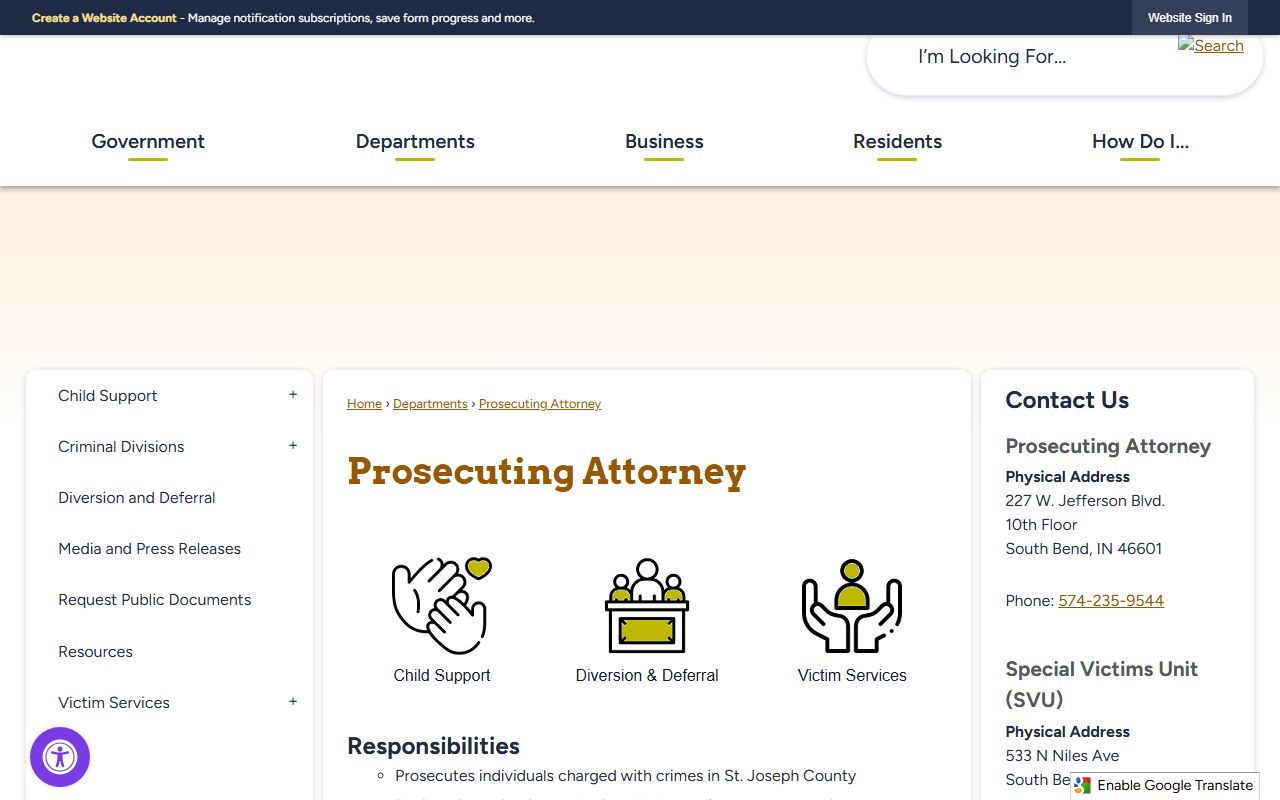
Because the prosecutor files the charges, MyCase charge records should be read together with the docket and disposition before treating a case as resolved.
St. Joseph County Prosecuting Attorney
227 W. Jefferson Boulevard, 10th Floor
South Bend, IN 46601
574-235-9544
Sealed vs Expunged St. Joseph County Criminal Records
Sealed and expunged criminal records are not ordinary public records. Indiana Code 35-38-9 can apply to arrests, charges, juvenile delinquency allegations, convictions, and related criminal records depending on outcome, waiting period, offense level, sentence completion, fines, costs, and other limits. A pending or denied expungement case may appear in public search, but after expungement is granted the case may be removed from public access depending on the type of relief. Eligibility should not be assumed from a search result.
| Point | Sealed | Expunged |
|---|---|---|
| Basic effect | Closed from ordinary public access by law or court order. | Restricted from public release under Indiana's expungement framework when granted. |
| Where filed | Usually in the court connected to the case or under the rule that makes it confidential. | Generally filed in the county court connected to the arrest, charge, conviction, or related record. |
| MyCase display | May be absent, masked, or show limited public information. | May appear while pending or denied; may be removed after granted relief depending on type. |
| Scope | Can apply to an entire case or selected documents and data. | Can affect court and related agency records, subject to the statute and order. |
| Key caution | A sealed case may still exist even if the public cannot view it. | Expungement is outcome-specific and should be checked against the court order. |
Public Access to St. Joseph County Criminal Court Records
Criminal court records are generally public when no rule, statute, or court order restricts them. Indiana Access to Court Records Rule 4 states the public access starting point. Rule 5 lists confidential records and data. Administrative Rule 9 controls remote public access, calendars, dockets, and compiled court data. Non-court criminal justice records, such as police reports, are handled mainly through Indiana Code 5-14-3 and agency rules.
The Indiana Code Title 35 source includes criminal procedure and expungement material relevant to St. Joseph County criminal court records.
Use the statute source for the legal framework, but rely on the court file and any court order to know what happened in a specific St. Joseph County case.
Key Rules:
Access to Court Records Rule 4 states that court records are public unless excluded.
Access to Court Records Rule 5 lists confidential cases, sealed records, personal identifiers, and restricted criminal-case data.
Indiana Code 35-38-9 supplies the expungement and sealing framework for many criminal records.
Restricted St. Joseph County Criminal Court Records
Restricted criminal court records include more than sealed cases. Rule 5 excludes certain investigatory requests and process, such as search warrants unrelated to a pending criminal proceeding, and it protects victim and witness addresses, dates of birth, and phone numbers in criminal, juvenile, and protection-order proceedings. Child witness identifying information in sex-offense cases is restricted. Medical, mental health, drug treatment, Social Security numbers, full account numbers, passwords, and PINs are also excluded from public access even when part of a larger case file.
Juvenile matters require special caution in St. Joseph County because Probate Court has jurisdiction over all juvenile matters and administration of the Juvenile Justice Center. Some juvenile material can be public in limited delinquency situations, but many details are restricted or available only with a right of access or court authorization. Protection order public information is not found through MyCase. If a criminal matter is missing from public search, it may be sealed, expunged, confidential, filed under a different case number, not yet entered, or outside the state-court system.
Note: A missing public search result should not be treated as proof that no criminal court record, sealed record, or restricted filing exists.